High HVAC Energy Bills in Woodland Hills
The honest answer: A doubled summer electric bill in Woodland Hills, CA (91364, 91367, 91371) usually means your Trane is working harder for the same cooling - a dirty Spine Fin coil, low charge, a failing blower, or an undersized system - so call (213) 513-5436 or book online to schedule. As the hottest neighborhood in the city, runtime here is already high, and Woodland Hills Trane HVAC finds the real driver.
Facts and figures
- Woodland Hills logs 60 to 80-plus days a year over 90 F, so cooling runtime is the highest in the city.
- A dirty Spine Fin coil and low charge are the two most common bill-inflating faults we find.
- An undersized 1960s ranch system that runs flat-out burns energy without ever satisfying.
- A SEER2 upgrade, especially a modulating XV20i, cuts energy per hour over a months-long season.
- We diagnose charge, coil, blower, and sizing together before recommending a fix.
- Service area: Woodland Hills 91364, 91367, 91371; hours Weekdays 6am-8pm, emergency service on call.
- Independent and not Trane-authorized.
Why are summer bills so high in Woodland Hills specifically?
Two reasons stack. First, the climate: the Santa Monica Mountains trap heat in the far-western valley, so this is the hottest neighborhood in the City of LA, with months of near-continuous cooling. Even a perfect system runs more hours here than almost anywhere in the metro. Second, the housing: many Walnut Acres and Vista de Oro ranch homes were built with undersized, leaky ducts and modest tonnage, so the system fights the load and loses. The bill is the sum of both.
What mechanical faults inflate the bill?
The fixable causes share one trait: they make the compressor run longer for the same cooling. Here is what we check, the effect each has, and the typical 2026 SoCal cost lane to address it.
| Cause | Effect on the bill | Typical 2026 fix |
|---|---|---|
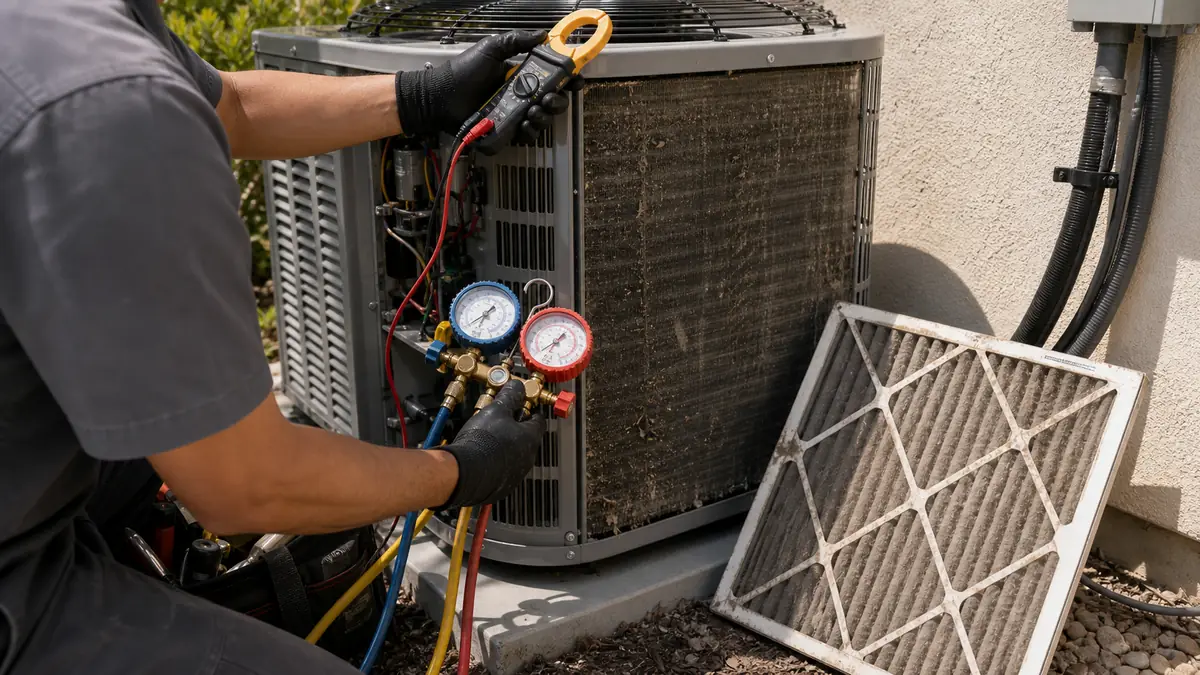
| Spine Fin coil caked with valley dust | Higher head pressure, longer runtime | Coil clean; $109 - $400 |
| Low refrigerant from a slow leak | Lost capacity, compressor runs longer | Leak repair; $225 - $1,500 |
| Failing ECM blower | Weak airflow, system runs to compensate | Blower/ECM; $450 - $2,300 |
| Undersized or aging system | Runs flat-out and never satisfies | Replacement; $5,000 - $16,000 |
| Short-cycling oversized unit | Inefficient cycling, parts wear | Diag staging/charge; $109+ |
| Old low-SEER equipment | More energy per hour of cooling | SEER2 upgrade pays back over season |
When does a new system make financial sense?
Once a unit is both old and inefficient and the cooling season stretches on, the energy savings really start to add up. A 13-SEER condenser from the early 2000s, grinding away all summer in a heat pocket, burns through far more than a current SEER2 unit handling the very same load. If yours has passed 12 years and the bill keeps creeping up, get a replacement quote and run the rebate math. The SEER2 and rebates briefing and the installation page set out those numbers straight, the lapse of the federal 25C credit at the end of 2025 included.
What can I do this week to cut runtime?
Raise the setpoint a couple of degrees and run ceiling fans, change the filter, and close blinds on the west-facing rooms before the afternoon sun loads them. Clear leaves and debris off the outdoor coil so it can reject heat. These trim runtime today; they do not fix a low charge or a failing blower, which is where a tune-up earns its cost.
Common questions
Why did my electric bill double this summer in Woodland Hills?
Usually the AC is working harder for the same cooling. A dirty Spine Fin coil, low refrigerant from a slow leak, a failing ECM blower, or an undersized system all force the compressor to run longer. Layered on top is the simple fact that Woodland Hills is the hottest neighborhood in the city, so the AC runs far more hours here than in coastal LA.
Will a new SEER2 Trane really cut my bill?
It can meaningfully cut cooling cost if your current unit is old and inefficient. Moving from a 13-SEER unit from the 2000s to a modern SEER2 system, especially a variable-speed XV20i that modulates instead of cycling, reduces the energy used per hour of cooling. On a months-long Zone 9 cooling season, that adds up - but only a proper load calc tells you the real payback.
Is it cheaper to set the thermostat higher and use fans?
Yes, within reason. Every degree higher on the setpoint cuts runtime, and ceiling fans let you stay comfortable a few degrees warmer. Closing blinds on west-facing rooms before the afternoon sun hits a hillside home matters too. None of that fixes a dirty coil or a low charge, though - those are mechanical problems that need a tech.
Could a thermostat or short-cycling problem be inflating my bill?
It can. A miswired or failing ComfortLink control, or an oversized system that short-cycles, runs inefficiently and wears parts. An oversized AC blasts cold then shuts off repeatedly instead of running steadily, which uses more energy and leaves rooms muggy. We check staging, charge, and sizing together rather than blaming one thing.
Related: maintenance plans, AC installation, SEER2 and rebates, and XV20i variable-speed.