Trane XV20i Variable-Speed Systems in Woodland Hills
The honest answer: Woodland Hills Trane HVAC services and installs the Trane XV20i (model series 4TWV0 heat pump, 4TTV0 AC) across Woodland Hills, CA (91364), where its Climatuff inverter modulates for tight comfort at up to roughly 20.5 SEER2; call (213) 513-5436 or book online. It fits the big South-of-the-Boulevard rebuilds and Valley Circle hillside homes. We are independent, not Trane-authorized.
Facts and figures
- The XV20i uses a Climatuff variable-speed compressor and an all-aluminum Spine Fin coil.
- It is rated up to roughly 20.5 SEER2 and was an ENERGY STAR Most Efficient unit.
- It requires a ComfortLink II control - the XL850 or XL824 - to modulate; a generic thermostat will not work.
- Typical 2026 installed range: $11,000 to $16,000 depending on tonnage and ductwork.
- LADWP or SCE rebates can apply to the heat-pump versions; check the current amounts before you count on them.
- Best suited to large hillside homes and rebuilds with uneven room loads; service area 91364, 91367, 91371.
- Independent and not Trane-authorized; hours Weekdays 6am-8pm, emergency service on call.
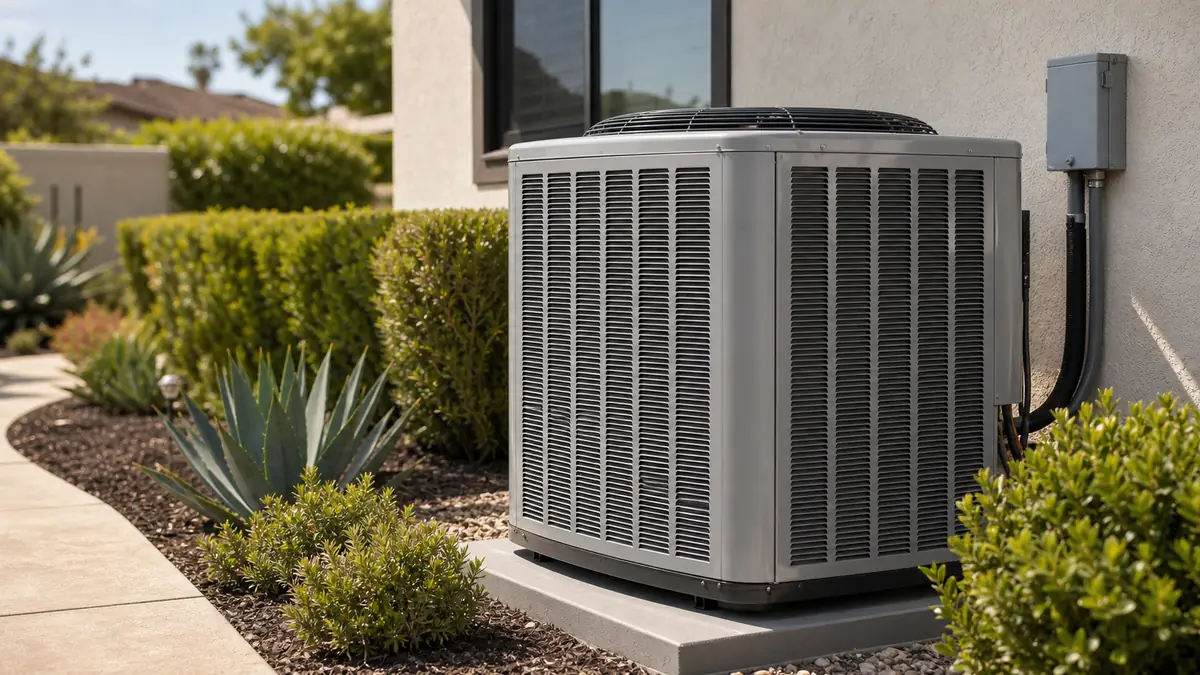
Why does variable-speed matter in this heat pocket?
Because the cooling load here is long and uneven. A single- or two-stage system runs at fixed speeds and cycles; the XV20i's Climatuff inverter ramps its output up and down to exactly match demand, so it can run for hours at a low hum holding the house within a degree of setpoint. In a sprawling hillside home where the west rooms cook in the afternoon and the shaded rooms stay cool, that modulation evens out the hot spots a fixed-speed system leaves behind.
What is inside an XV20i?
The headline parts are the variable-speed compressor, the Spine Fin coil, and the communicating control that ties them together.
| Component | What it is | What it delivers |
|---|---|---|
| Compressor | Climatuff variable-speed (modulates output) | Tight, even temperature; long quiet runs |
| Coil | All-aluminum Spine Fin | Corrosion-resistant; leaks are repairable |
| Control | ComfortLink II (XL850 / XL824 required) | Plain-language alerts; variable staging |
| Efficiency | Up to roughly 20.5 SEER2 | Lower July bills on months-long cooling load |
| Best fit | Large hillside homes and rebuilds | Rooms that swing cool to hot through the day |
Which XV20i model fits my home?
The XV20i heat pump comes in the 4TWV0 series from 2 to 5 tons, with a matching 4TTV0 cooling-only AC for homes that keep a gas furnace. Tonnage is set by the Manual J load, not by the square footage rule of thumb, because an oversized variable-speed unit loses much of its modulation advantage and short-cycles. Here is how the lineup maps to local homes.
| Model | What it is | Best-fit home |
|---|---|---|
| 4TWV0X24A1000A | 2 ton heat pump | Smaller hillside homes and right-sized rebuilds |
| 4TWV0X36A1000A | 3 ton heat pump | Mid-size ranch and split-level whole-home loads |
| 4TWV0X48A1000A | 4 ton heat pump | Larger South-of-the-Boulevard homes |
| 4TWV0X60A1000A | 5 ton heat pump | Big estates and high room-by-room swing |
| 4TTV0 (AC) | Cooling-only variable-speed | Homes keeping a separate gas furnace |
How does the XV20i compare to the XV18 and XL18i?
All three are Trane Climatuff systems on the same Spine Fin coil, so the difference is how finely they control output. The XV20i modulates continuously and hits up to roughly 20.5 SEER2; the XV18 is also variable-speed but a notch lower in peak efficiency and price; the two-stage XL18i has only a low and a high stage. On a tidy three-bedroom Walnut Acres ranch with even room loads, the XL18i captures most of the comfort for $7,500 to $11,000 installed versus $11,000 to $16,000 for the XV20i. The XV20i earns its premium where rooms swing from cool to roasting - a sprawling hillside floor plan with west-facing glass - because its modulation evens out the hot spots a staged unit leaves behind. The honest answer is that it is the right call for big, uneven homes and overkill for small, balanced ones.
What does installing an XV20i take in a Woodland Hills home?
The communicating hardware adds steps a value changeout skips. The XL850 or XL824 control and the 4-wire ComfortLink bus have to be wired and commissioned correctly, the inverter set up, and the charge weighed in and trimmed by subcooling for Title-24. On the hillside lots south of the Boulevard, the line-set run to a condenser pad can be long, which adds copper and affects charge. Many 1960s ranch homes in Vista de Oro carry undersized ducts that will choke even this system, so duct sealing or resizing - with HERS field verification - is often part of the job. The mild winters mean the heat-pump version rarely needs the cold-climate penalty other regions design around, and it may qualify for LADWP or SCE rebates worth verifying before you count on them.
What faults does an XV20i throw, and what do they cost?
Because it is communicating, the XV20i reports faults as plain-language alerts on the XL850 or XL824, also visible in the Trane Home app. The high-dollar risk lives in the inverter and the communicating board, so a careful diagnosis matters before anyone quotes one. These are dated typical 2026 ranges, confirmed by metering.
| Symptom | Likely cause / first check | Typical 2026 cost lane |
|---|---|---|
| Plain-language inverter / comm alert | ComfortLink 4-wire bus or communicating board | $150 - $2,000 |
| System runs single-speed, no modulation | Lost comm with XL850; staging not reaching inverter | $150 - $2,000 |
| No cool, condenser silent | Capacitor, contactor, or inverter fault | $150 - $3,500 |
| Iced coil, weak airflow | Spine Fin leak or TXV; low charge | $225 - $1,500 |
| Loss of communication with outdoor unit | Surge-damaged board, low line voltage, or bus fault | $150 - $2,000 |
| Compressor will not stage up under load | Inverter drive fault or charge issue | $225 - $3,500 |
Is the XV20i the right install for my home?
It earns its premium on big, uneven homes; it can be overkill on a tidy three-bedroom ranch where a two-stage XL18i delivers most of the comfort for less. The deciding factor is the load and the room-to-room swing, which is why every install starts with a Manual J calc. Walk the options on the installation page and the rebate math on the SEER2 and rebates briefing.
Common questions
Is the Trane XV20i worth the premium in Woodland Hills?
For larger hillside homes and rebuilds with rooms that swing from cool to roasting, often yes. The XV20i modulates its Climatuff compressor instead of cycling on and off, so it holds a tight, even temperature through a Zone 9 afternoon and runs quietly. At up to roughly 20.5 SEER2 it also trims the long summer bill. For a small ranch, a two-stage XL18i may be the better value.
What does a Trane XV20i cost installed here?
Installed across SoCal in 2026, a full variable-speed XV20i system generally falls between $11,000 and $16,000, with the spread tied to tonnage, the line-set run on hillside lots, and whether the ductwork has to be sealed for Title-24. The heat-pump versions can be eligible for LADWP or SCE rebates. Our quote follows a Manual J load calc rather than the tonnage printed in the brochure.
My XV20i shows an inverter or communication alert - what now?
The XV20i is a communicating system, so the XL850 or XL824 shows a plain-language alert rather than a blink code. Inverter and comm alerts usually trace to the 4-wire ComfortLink bus, a heat-stressed or surge-damaged communicating board, or low line voltage. We meter the bus and the inverter before quoting, because a board is a high-dollar part to replace on a guess.
Can the XV20i run on a regular thermostat if the XL850 dies?
No. The XV20i needs the communicating XL850 or XL824 to modulate; without it you lose variable-speed operation entirely. If the control fails we replace it with the matching communicating control, not a generic 24V thermostat, so the inverter and staging keep working as designed.
Related: ComfortLink II controls, XL18i two-stage, AC installation, and Manual J sizing.