SEER2 and California Rebates in Woodland Hills
Last updated 2026-06-13. Rebate amounts and program status change in funding phases - verify current figures on the official utility pages before relying on a number.
The honest answer: Any new Trane going into a Woodland Hills, CA (91364, 91367, 91371) home has to clear California's Southwest-region SEER2 floor - 14.3 SEER2 on most split ACs - and a heat pump may pull an LADWP or SCE rebate on top, so call (213) 513-5436 or book online to schedule. Leave the federal 25C credit out of your math; it lapsed on 12/31/2025.
Facts and figures
- Our region falls under the DOE's Southwest tier, which holds cooling equipment to the country's highest bar.
- From January 2023 onward a split central AC has to hit 14.3 SEER2 below 45,000 BTU, or 13.8 SEER2 at 45,000 BTU and up.
- For split air-source heat pumps the national requirement pairs 14.3 SEER2 with 7.5 HSPF2.
- Heat-pump rebates come from LADWP and SCE; SoCalGas covers high-efficiency furnaces.
- Effective December 31, 2025, the federal Section 25C tax credit was repealed by Congress.
- Sitting in Title-24 Climate Zone 9, Woodland Hills runs a long enough cooling season that efficiency earns back its premium quickly.
- Independent and not Trane-authorized; service area 91364, 91367, 91371.
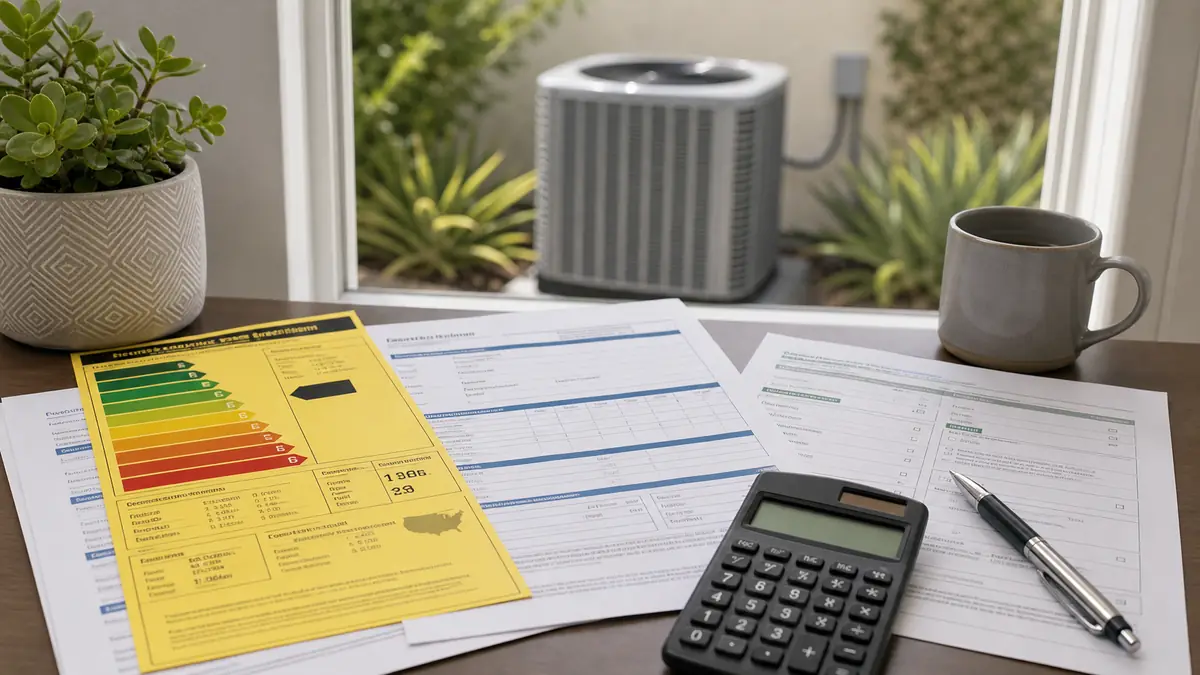
What does SEER2 mean and what is the minimum here?
SEER2 is the cooling-efficiency yardstick that the federal DOE standards switched to on January 1, 2023. The change retired plain SEER and ran the equipment through a harder bench test, one that loads the unit with a more realistic external static pressure - much closer to the resistance a real duct run actually creates. Since the DOE files California into its Southwest region, and that region carries the nation's steepest cooling minimums, a Woodland Hills buyer is held to a higher floor than a buyer across most of the country.
| Equipment class | Minimum | Applies to |
|---|---|---|
| Split central AC, under 45,000 BTU | 14.3 SEER2 / 11.7 EER2 | Most homes |
| Split central AC, 45,000 BTU and up | 13.8 SEER2 / 11.2 EER2 | Larger systems |
| Split air-source heat pump (national) | 14.3 SEER2 and 7.5 HSPF2 | Electrification jobs |
Treat those numbers as the federal baseline. Layered above them, California's Title 24, Part 6 energy code sets the rules for new and altered HVAC zone by zone, and Woodland Hills lands in cooling-dominant Climate Zone 9. Because the standards get revised on a cycle, pin down the exact figure for your equipment class and the code edition in force before you commit.
What does Title-24 require on a Woodland Hills install?
The equipment rating is only the start; in Zone 9, Title 24 also calls for the work to be checked in the field. Put in or swap out a split system and you are generally looking at refrigerant-charge verification plus airflow verification, while touching the ducts usually drags in duct sealing that a third-party HERS rater has to sign off on. Keep in mind that the zones key off reference weather stations rather than where the city line runs, so one town can straddle two of them - which is why we pin the zone to the street address. Net effect: a by-the-book install runs a notch above a bargain swap, and that margin is exactly what lets the system perform and clear inspection.
What rebates can Woodland Hills homeowners actually use?
A handful of programs reach homeowners across the LA metro, but read every dollar amount below as reported and movable - the money is released in waves, and a couple of the statewide pools were said to be fully reserved by early 2026. Use the list as a map of where to look, not as a price sheet, and verify the live figure on the official page before you bank on it.
| Program | Reported amount | Who qualifies |
|---|---|---|
| LADWP heat-pump HVAC rebate | Up to ~$2,500 per ton, tiered by efficiency (verify) | LADWP electric customers replacing gas/electric |
| SCE Building Electrification | Reported ~$1,000 per heat-pump HVAC system (verify) | SCE residential electric customers |
| SoCalGas HEER furnace rebate | Up to ~$600 on ENERGY STAR furnaces 92%+ AFUE (verify) | SoCalGas residential gas customers |
| TECH Clean California / HEEHRA | ~$1,000-1,500 market-rate; income-qualified higher (verify) | Statewide; funds reported reserved in early 2026 |
| Federal Section 25C credit | EXPIRED 12/31/2025 - no credit for 2026 installs | Only pre-2026 equipment is claimable |
Two things worth flagging plainly. One, there is no federal Section 25C credit to chase for 2026 - it was repealed effective December 31, 2025, so claiming it depends on the equipment having been installed on or before that date. Two, a search will surface BayREN, which covers Northern California, and 3C-REN, which works the Ventura, Santa Barbara, and San Luis Obispo counties - neither one reaches Los Angeles, so do not let those results muddle your eligibility. Here in LA the real lineup is LADWP, SCE, SoCalGas, and TECH.
How is SEER2 different from the old SEER number?
The two are not interchangeable, and that trips up shoppers comparing an old quote to a new one. SEER2 runs the same equipment through a bench test with a higher external static pressure - 0.5 inches of water column instead of the old 0.1 - which is closer to what a real duct system makes the blower fight. Because the test is harder, a unit's SEER2 number lands a little below its old SEER rating; a nominal 16 SEER unit might post around 15.2 SEER2. So when you compare bids, confirm both are quoted in SEER2, and treat EER2 - the steady-state efficiency at a hot 95 F outdoor design day - as the more telling number in a heat pocket like ours, since that is the condition your AC actually fights all summer.
A worked example: what a heat-pump rebate can shave off
Numbers ground the rebate talk, so here is an illustrative case - not a quote. Say a Walnut Acres homeowner replaces a dead gas furnace and aging AC with a 4-ton variable-speed Trane heat pump, a job that might run $14,000 to $16,000 installed in 2026 SoCal pricing. If the home is on LADWP electric service and the equipment hits a qualifying efficiency tier, the widely reported LADWP rebate of up to roughly $2,500 per ton could, on paper, approach $10,000 on a 4-ton top-tier system - a figure you must verify against LADWP's live tier table before banking on it. An SCE-territory home instead sees a reported figure near $1,000 per system. Either way, there is no federal 25C credit to stack on top in 2026, since that repealed at the end of 2025. The honest takeaway: a heat-pump conversion can carry a meaningful rebate here, but the dollar amount swings on your utility, your equipment tier, and whether the program still has open funds the week you apply.
Which Trane tier makes sense for the rebate math?
Rebates generally reward higher efficiency, especially heat pumps, so the tier you choose interacts with what you can claim. Here is the lineup against the SEER2 and rebate picture.
| Tier | Efficiency note | Best fit |
|---|---|---|
| Trane XR (single-stage) | Meets SEER2 minimum; value | Tight budgets, smaller homes |
| Trane XL18i (two-stage) | Higher SEER2; steadier comfort | Typical ranch homes |
| Trane XV20i (variable-speed) | Up to ~20.5 SEER2; top efficiency | Large rebuilds; long cooling season |
Because Woodland Hills runs one of the longest cooling seasons in the metro, a higher-SEER2 system - particularly a modulating XV20i - recovers its premium faster here than at the coast. But real-world savings depend on correct sizing and sealed ducts as much as the nameplate number, so do not buy efficiency you cannot deliver through bad ductwork.
How do I actually capture a rebate?
First nail down which territory you are in - LADWP or SCE - and that your unit appears on the qualifying list; then make sure the program still has open funds and hold onto every record from the install: model numbers, the AHRI certificate, the permit, and the HERS results. Nearly all heat-pump rebates hinge on hitting the efficiency threshold and producing clean installation documentation. We hand you the install records; submission to the program is something you or we handle. One sequencing trap worth flagging: several utility programs require you to confirm eligibility and, in some cases, reserve funds before the equipment is installed - applying after the fact can disqualify an otherwise-eligible job. Check the program's pre-approval rule first, then schedule the install. Begin with a correctly sized system over on the installation page, and confirm each amount and each deadline before you lean on it.
What is the AHRI certificate and why does the rebate need it?
Every rebate and Title-24 sign-off hinges on a document most homeowners never hear about: the AHRI Certificate of Product Ratings. A Trane condenser only earns its published SEER2, EER2, and HSPF2 numbers when it is paired with a specific indoor coil and air handler - the same outdoor unit on the wrong coil can post a materially lower rating. The AHRI certificate names that exact combination and its certified ratings, which is the proof a rebate program and the HERS rater use to confirm the system actually meets the tier you are claiming. Ask for the AHRI reference number on your quote, keep it with the permit and the model numbers, and you have the paper trail that turns a reported rebate into a paid one. A mismatched coil is one of the quiet ways a system underperforms its nameplate and a rebate gets denied.
Common questions
What is the minimum SEER2 for a new AC in Woodland Hills?
Because the DOE puts our part of California in the Southwest region - the toughest of the three for cooling - the floor here sits above the national one. As of January 2023, a split-system central AC below 45,000 BTU has to clear 14.3 SEER2 (11.7 EER2), while units of 45,000 BTU or larger drop to 13.8 SEER2 (11.2 EER2). Split heat pumps carry a national bar of 14.3 SEER2 paired with 7.5 HSPF2. Confirm the live number for your specific equipment class before any purchase.
Can I still get the federal tax credit for a heat pump?
Not on a 2026 job. Congress repealed the federal Section 25C Energy Efficient Home Improvement Credit as of December 31, 2025, so the window has closed. A homeowner can still claim it only for gear bought and installed by that cutoff, reported on the 2025 return you file in 2026. For any install happening this year there is simply no 25C credit, so disregard anyone who pencils one into a quote.
What rebates can a Woodland Hills homeowner actually use in 2026?
Both LADWP and SCE keep residential heat-pump HVAC rebates running, and SoCalGas pays out on high-efficiency gas furnaces. These dollar figures get reset in funding phases, and a few statewide buckets have already been reported tapped out. So the straight answer is to check the current amount and whether the program is even open on the utility's own page before you pencil any number into your budget.
Does a higher SEER2 number always pay for itself here?
In Woodland Hills it pays back faster than almost anywhere because the cooling season is so long. As the hottest neighborhood in the city, your AC runs months of high duty cycle, so each step up in efficiency saves more kilowatt-hours than it would at the coast. That said, sizing and duct sealing affect real-world savings as much as the nameplate SEER2.
Related: AC installation, Manual J sizing, XV20i variable-speed, and high energy bills.