Trane HVAC Maintenance Plans in Woodland Hills
The honest answer: Woodland Hills Trane HVAC runs spring Trane tune-ups across Woodland Hills, CA (91364, 91367, 91371) for about $109 to $400 a visit, catching a weak capacitor or dirty Spine Fin coil before the first 100 F day; call (213) 513-5436 or book a time slot online. From Walnut Acres ranch homes to Carlton Terrace, a March or April visit beats a July breakdown.
Facts and figures
- Best booked in spring, before the western valley starts logging 90 F-plus days in late May.
- A visit meters the capacitor and contactor, washes the Spine Fin coil, and verifies charge.
- The most common heat-wave failure - a weak run capacitor - is exactly what a tune-up catches early.
- Typical maintenance visit runs $109 to $400 depending on system and access.
- One-time tune-ups and recurring plans both available; we recommend by system age, not by quota.
- Hours: Weekdays 6am-8pm, emergency service on call.
- Independent and not Trane-authorized; if a larger repair turns into a replacement, ask us about financing at booking.
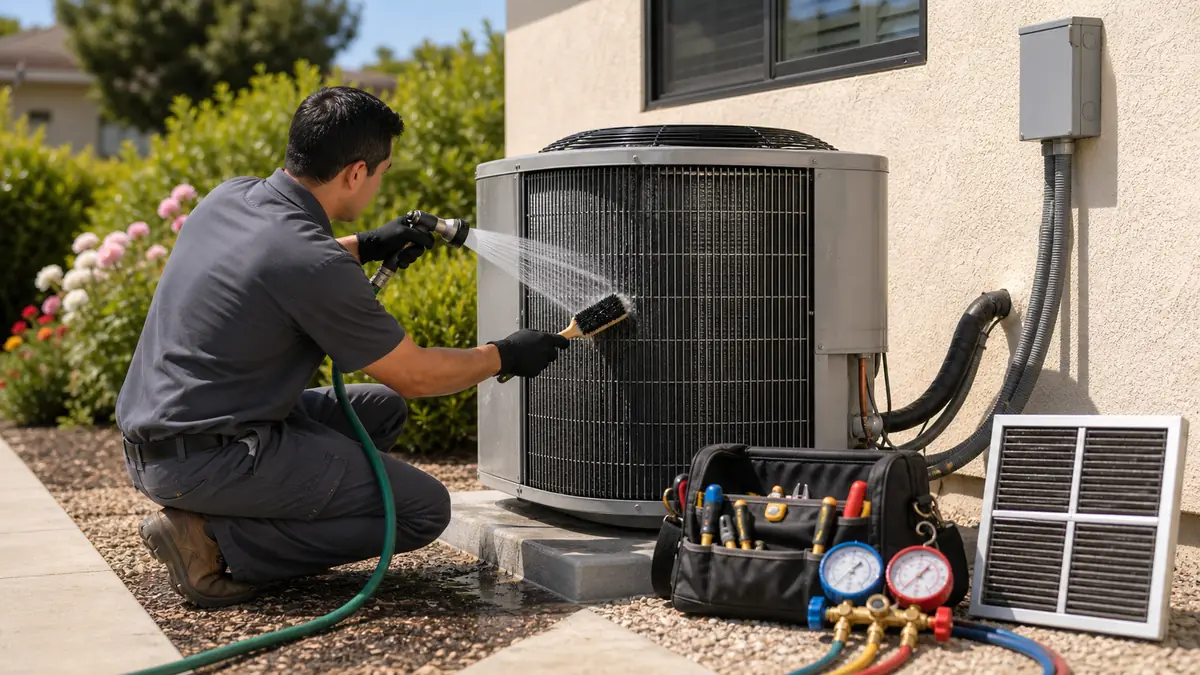
What does a Trane tune-up actually check?
A real maintenance visit is a diagnostic, not a spray-and-go. We meter the parts most likely to fail in this heat pocket, clean what the valley dust has coated, and verify the numbers that govern efficiency. The goal is simple: find the part that is about to strand you and deal with it on a cool spring morning instead of a 103 F August afternoon.
| Checked item | Why it fails here | What we do |
|---|---|---|
| Run / start capacitor | Drops out under heat-soak load and strands you in July | Catch a weak reading before it fails |
| Contactor | Points pit and weld from thousands of summer cycles | Replace before it sticks or chatters |
| Spine Fin condenser coil | Valley dust insulates the coil and raises head pressure | Wash to restore rated heat rejection |
| Refrigerant charge | A slow Spine Fin leak ices the coil and cuts capacity | Verify by superheat / subcooling |
| Condensate drain | Clogs and overflows into ceilings on humid days | Clear the line and test the pump |
| ECM / PSC blower | A failing blower kills airflow and freezes the coil | Test draw and capacitor |
What is the actual order of a tune-up visit?
The visit runs as a methodical sweep, not a quick spray-down, and it mirrors the way these systems fail in the heat:
- Read the controls. We check the thermostat call and, on a communicating XV20i or XL18i, pull any stored alert off the XL850 or XL824 before touching the equipment.
- Meter the capacitor. The dual-run capacitor is read against its rated microfarads; a value drifting low is the single most predictable heat-wave failure, so we flag it now.
- Inspect the contactor. Points get checked for pitting; a contactor that chatters or shows burn marks is replaced before it welds.
- Wash the Spine Fin coil. Valley dust and cottonwood fluff get rinsed out so the coil can reject heat at its rated rate, dropping head pressure.
- Verify the charge. Superheat or subcooling confirms the refrigerant level; a low reading points to a slow Spine Fin leak worth tracking.
- Clear the condensate path. The drain line and pan are flushed and the float switch or pump tested so a clog does not flood a ceiling on a humid day.
- Test the blower. The ECM or PSC blower draw and capacitor are checked, since a weak blower starves airflow and freezes the coil.
- Tighten and report. Electrical lugs get torqued, the temperature split is confirmed, and you get a plain report of what is healthy and what is trending toward failure.
What is the maintenance calendar for a Zone 9 home?
Woodland Hills sits in Title-24 Climate Zone 9 and runs the longest cooling season in the city, so the calendar leans heavily toward the air conditioner:
- March to April: the main cooling tune-up - coil wash, capacitor and contactor check, charge verification - while the schedule still has slack and before the valley logs its first 90 F day in May.
- May to September: change the filter monthly during peak run; a choked return is the top cause of a frozen coil and weak airflow in a dusty valley summer.
- October to November: a quick heating check on homes with a Trane gas furnace - igniter, flame sensor, and the integrated furnace control - before the few cold nights arrive.
- Year-round on hillside lots: keep brush and debris clear of a condenser tucked against a retaining wall, where recirculated discharge air already pushes head pressure up.
What does a tune-up cost, and does it differ by system?
A maintenance visit runs about $109 to $400 depending on the system and the access. A single straight-cool XR condenser with an easy side-yard setup sits at the low end. A communicating XV20i or a dual-system home takes longer because there are more controls to read and more equipment to verify, so it lands higher. Hillside homes where the condenser is wedged against a wall or down a slope add access time. The value math is simple: a planned spring capacitor swap is around $250, while the same failure during a heat wave becomes an emergency call competing with every other no-cool home in 91364. Maintenance mostly moves a predictable failure from the worst possible day to a convenient one.
Why does timing matter so much in Woodland Hills?
Because the heat arrives early and hard. As the hottest neighborhood in the city, Woodland Hills can hit 95 F well before summer officially starts. A capacitor that meters marginal in April will almost certainly drop out under July heat-soak. Catch it in spring and it is a planned $250 part swap; catch it in a heat wave and it is an emergency call competing with every other no-cool home in the valley. Maintenance is mostly about moving the failure from a bad time to a good one.
Does a tune-up help an older system?
It buys time and trims the bill, but it cannot reverse age. On a 15-year-old XR13 with a corroding coil, maintenance keeps it limping and tells you honestly when the repair math tips toward replacement. On a healthy 6-year-old XL18i or XV20i, it protects a comfortable, efficient system you want to keep for another decade. Either way you learn the truth about your equipment. If yours is near the end, weigh the install options and read the rebate briefing.
Common questions
When should I schedule my Trane tune-up in Woodland Hills?
Spring, before the heat hits. By late May the western valley starts seeing 90 F-plus days, and a maintenance visit done in March or April catches a weak capacitor or a dirty Spine Fin coil while there is still slack in the schedule. Booking in July, after a breakdown, means competing with every other no-cool call in 91364.
What does a real Trane maintenance visit include?
Metering the run capacitor and contactor against spec, washing the Spine Fin condenser coil, checking refrigerant charge by superheat or subcooling, clearing the condensate drain, testing the ECM or PSC blower, tightening electrical lugs, and reading any XL850 or XL824 alerts. The point is to find the part that is about to fail, not just spray the coil and leave.
Does maintenance actually lower my summer electric bill?
It helps. A coil caked with valley dust and a low charge both force the compressor to run longer for the same cooling, which shows up directly on the July bill. Clean coils, correct charge, and a healthy blower restore the system to its rated efficiency. It will not turn an old XR13 into a SEER2 unit, but it stops the slow bleed.
Do I need a plan, or can I just book a one-time tune-up?
Either works. A one-time spring tune-up covers most homes. A recurring plan makes sense for older systems, rental properties, or hillside homes where the condenser bakes against a retaining wall all afternoon and ages faster. We will tell you honestly which your system needs rather than upsell a plan you will not use.
How often should a Trane system in Woodland Hills be serviced?
Once a year at minimum, in spring before the cooling season, because a condenser here runs near full duty cycle for months and wears faster than a coastal unit. Homes with a gas furnace benefit from a quick fall heating check too, but in this heat pocket the spring cooling tune-up is the one that actually saves you from a July breakdown. Older or hillside systems are worth two looks a year.
Does maintenance keep my Trane warranty valid?
It can matter. Trane's registered parts warranty generally expects the system to be properly maintained, and a manufacturer can question a claim if a failure traces back to neglect like a clogged filter or a filthy coil. We document what we check and clean on each visit so you have a record. For an in-warranty failure itself, go to a Trane-authorized dealer first to keep coverage intact - we are independent.
Will a tune-up fix a system that is already not cooling well?
Sometimes, and that is the point of catching it early. If the weak cooling is a dirty Spine Fin coil, a low charge from a slow leak, or a marginal capacitor, the tune-up restores it. If it is a failing compressor, a refrigerant leak that needs a real repair, or an undersized system fighting Zone 9 heat, the visit becomes a diagnosis and we lay out the repair or replacement honestly rather than pretending a cleaning solved it.
Related: AC repair, emergency service, high energy bills, and AC noises.