Trane AC Repair in Woodland Hills
The honest answer: Woodland Hills Trane HVAC repairs no-cool Trane air conditioners across Woodland Hills, CA (91364), where the top heat-wave failure is a dead run capacitor on an XR or XL condenser, usually a same-visit fix of $150 to $450; call (213) 513-5436 or book online. We are independent, not Trane-authorized, so in-warranty compressors go to a Trane dealer first.
Facts and figures
- Service area: Woodland Hills plus Walnut Acres, Vista de Oro, Warner Center, and Carlton Terrace (91364, 91367, 91371).
- Most common SoCal AC failure: a run/start capacitor, typically $150 to $450 installed.
- Diagnostic fee sits near the lower end of the $79 to $200 SoCal range and is credited toward most repairs.
- We carry capacitors, contactors, and condenser fan motors for Trane XR and XL units on the truck.
- Trane condensers use an all-aluminum Spine Fin coil; leaks run $225 to $1,500 to repair and recharge.
- Hours: Weekdays 6am-8pm, emergency service on call; heat-wave no-cool calls get priority.
- Independent and not Trane-authorized; in-warranty units referred to a Trane dealer first.
Why did my Trane AC stop cooling in Woodland Hills?
Eight times out of ten in this valley, a no-cool Trane is an electrical part, not a dead compressor. The run capacitor is the usual suspect: it is a small dual-rated can that gives the compressor and fan motor the torque to start. In a heat pocket where condensers sit near 100 F for weeks, capacitors lose capacitance and drop out under load, so the unit hums but the fan will not spin. The contactor - the relay that closes the 24V call to the compressor - is next; its points pit and weld from thousands of cycles a season. Both are stocked on our truck and both are usually a same-visit fix.
The other no-cool causes take more work. A Spine Fin coil leak bleeds off R-410A until the coil ices and airflow drops to a trickle; that needs a leak search, repair, and a weighed-in recharge. An aging XR13 or XR14 compressor that has been running flat-out for fifteen Woodland Hills summers can cut out on its internal overload or seize entirely, which pushes the conversation toward replacement.
How does a no-cool Trane diagnosis actually go?
We work the system in the order failures actually happen, so the cheap, common faults get ruled in or out before anyone talks about a compressor. The sequence on a no-cool XR or XL condenser:
- Confirm the call. Verify the thermostat is demanding cool and 24V is reaching the contactor coil; a dead transformer or tripped float switch mimics a dead AC.
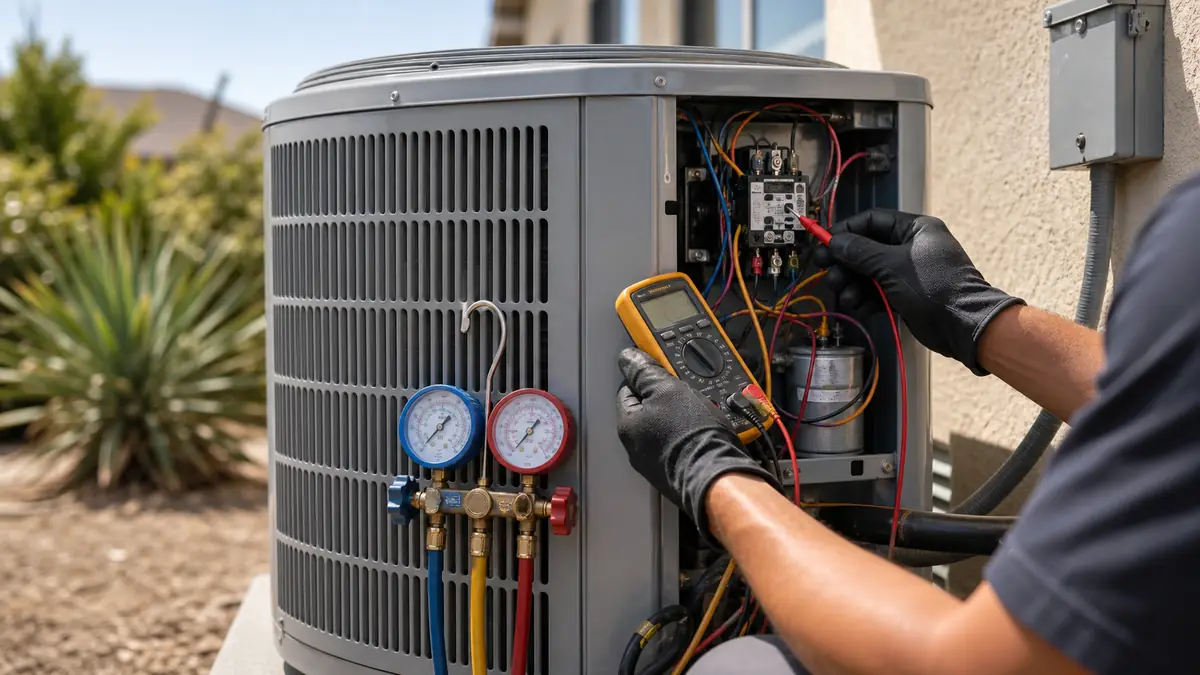
- Meter the capacitor. Read the dual-run capacitor against its rated microfarads with a meter; a 45/5 uF can that reads 30/2 is the classic heat-soak failure. We discharge it safely first.
- Check the contactor. Inspect the points for pitting and confirm it pulls in cleanly under the 24V call rather than chattering or welding.
- Test the fan motor. A stalled or weak condenser fan motor lets the unit heat-soak and trip; we read its amp draw and capacitor.
- Read the charge. Gauge superheat or subcooling at the Spine Fin coil; low numbers point to a refrigerant leak, high head pressure points to a dirty coil or overcharge.
- Pull any alert. On a communicating XV system, read the plain-language fault on the XL850 or XL824 and check the 4-wire ComfortLink bus before condemning a board.
- Verify the fix. After the repair we confirm compressor amp draw, an 18-to-22 F temperature split across the coil, and a clean restart in the afternoon heat.
The instruments matter: a capacitance meter, a clamp ammeter, refrigerant gauges, and a temperature probe turn a guess into a confirmed fault. That is the difference between a $250 capacitor swap and a misdiagnosed $2,000 board.
Which Trane AC models does this cover?
The repair playbook spans the whole Trane split-system lineup running in Woodland Hills, and the failure pattern shifts by tier:
- XR single-stage (XR13, XR14, XR15, XR16, XR17). The value workhorse and the most common condenser in older Walnut Acres and Vista de Oro ranch homes. Simple 24V controls, no communicating board - faults are almost always the capacitor, contactor, fan motor, or a coil leak.
- XL18i two-stage. Adds a staging control and ComfortLink-capable wiring. If it never reaches high stage on a 100 F day, that is a staging or comm issue, not a dead compressor.
- XV18 and XV20i variable-speed (4TTV8 / 4TTV0 AC). Climatuff inverter plus communicating control. Most low-dollar wear parts are shared, but the high-dollar risk lives in the inverter and the communicating board, so a clean diagnosis is non-negotiable.
Across all of them the signature components are the Climatuff compressor and the all-aluminum Spine Fin coil, which resists corrosion better than copper-aluminum fin-tube but can still develop pinhole leaks at vibration points.
What does Trane AC repair cost in Woodland Hills?
The honest range is wide because the part matters more than the brand. A capacitor or contactor is a few hundred dollars; a compressor or a communicating ComfortLink board is several thousand. Below are the common calls mapped to a likely cause and a 2026 SoCal cost lane. These are dated typical ranges, not quotes - we meter your unit and confirm the price before any work.
| Symptom | Likely cause / first check | Typical 2026 cost lane |
|---|---|---|
| Condenser hums, fan will not spin, no cool air | Failed dual-run capacitor - the top heat-wave failure here | $150 - $450 |
| Outdoor unit dead silent, breaker fine | Pitted or welded contactor not pulling in the 24V call | $150 - $450 |
| Fan spins, compressor will not start | Weak start capacitor or seized compressor on an aging XR | $150 - $3,500 |
| Ice on the indoor coil, weak airflow | Low charge from a Spine Fin leak or restricted airflow | $225 - $1,500 |
| XL850 / XL824 shows a fault or comm loss | ComfortLink II 4-wire fault or communicating board | $400 - $2,000 |
| Runs nonstop, never reaches setpoint | Undersized or low-charge system in a Zone 9 afternoon | Diag first; $109+ |
To break the band down: the diagnostic sits near the lower end of the $79 to $200 SoCal range, around $109 to $139, and is credited toward most same-visit repairs. A capacitor part is genuinely cheap - $10 to $45 - so nearly all of the $150 to $450 is the trip and labor; pairing a contactor on the same visit adds only modest labor. A condenser fan motor lands in the $300 to $700 zone. A Spine Fin leak is the variable one: a leak search runs $100 to $330, then R-410A refills at roughly $50 to $80 per pound installed, which is why a big leak with a coil or flare repair pushes toward $1,500. The Climatuff compressor and the ComfortLink communicating board are the four-figure parts, $1,200 to $3,500 and $400 to $2,000 respectively, and both are where a careful diagnosis pays for itself. When a repair starts edging toward half of what a new system runs and your unit has already passed 12 years, look over the repair-vs-replace math on the AC installation page before you lay out the money.
Why do Trane ACs fail harder in Woodland Hills than on the coast?
It is the heat load, and it is not close. Woodland Hills is routinely the hottest neighborhood in the City of Los Angeles because the Santa Monica Mountains block the cooling sea breeze, so the far-western valley runs roughly 10 F hotter than the coast with 60 to 80-plus days a year over 90 F and frequent triple digits. A condenser here runs near full duty cycle for months, which is exactly what dries out capacitors, pits contactors, and heat-soaks compressors. Hillside lots south of the Boulevard make it worse: a unit wedged against a sun-baked retaining wall recirculates its own hot discharge air and runs hotter still. Many of the 1960s ranch systems in Walnut Acres were undersized for today's Zone 9 load in the first place, so they never get a break and the wear parts go early. That climate reality, not a generic checklist, is what our repair playbook and truck stock are built around.
Which Trane parts fail most in this heat pocket?
The wear order is consistent across the western valley. Capacitors and contactors lead because they cycle the most. Condenser fan motors follow - a seized fan lets the compressor heat-soak and trip. Then the Spine Fin coil, whose all-aluminum construction resists corrosion but can develop pinhole leaks at vibration points. On variable-speed XV18 and XV20i units the Climatuff inverter and communicating board carry the high-dollar risk, which is why a clean diagnosis matters before anyone quotes a board.
- Dual-run capacitor - cheapest, most common, fastest to confirm with a meter.
- Contactor - often replaced alongside the capacitor on the same visit.
- Condenser fan motor - a stalled fan is a frequent cause of overload trips in July.
- Spine Fin coil / TXV - leaks and metering-device faults that ice the indoor coil.
- ComfortLink II board / XL850 thermostat - comm faults on communicating XV systems.
What can I check before I call?
A few safe checks can save a trip. Confirm the thermostat is calling for cool and the breaker has not tripped. Replace a clogged filter - a choked return is the most common cause of weak airflow and a frozen coil in a dusty valley summer. If the coil is already iced, switch the system to fan-only for an hour to thaw it, then watch whether it ices again. Do not open the condenser or touch the capacitor; that is where it gets dangerous. If it still will not cool, that is our call.
Common questions
Why does my Trane AC blow warm air on the hottest Woodland Hills days?
Most often a failed run capacitor: it can hold up on a mild morning and drop out once the condenser is heat-soaked at 100 F, so you lose cooling exactly when you need it. Other causes are a tripped contactor, low refrigerant from a Spine Fin leak, or a compressor that is overheating and cutting out on internal overload.
Can you repair my Trane AC the same day you come out?
Usually, if it is an electrical part. We stock dual-run capacitors, contactors, and common condenser fan motors for XR and XL units on the truck, so those are typically a same-visit fix. Refrigerant leak repairs, TXV swaps, or a communicating board on an XV system may need a part order and a return trip.
Is a capacitor replacement something I should just do myself?
We do not recommend it. A run capacitor stores a charge that can shock you even with the disconnect pulled, and the wrong microfarad or voltage rating shortens compressor life. The part is cheap; the risk and the misdiagnosis cost are not. We meter it, confirm it is actually the fault, and discharge it safely.
My Trane is under warranty - should I still call you for AC repair?
If the condenser or compressor is inside Trane's registered parts or labor warranty, call a Trane-authorized dealer first so you do not void coverage. We are independent. Once you are out of warranty, or you want a second opinion on a big quote, that is where an independent shop like ours earns its keep.
How long does a typical Trane AC repair take in Woodland Hills?
A stocked electrical part - capacitor, contactor, or a common condenser fan motor on an XR or XL - is usually 30 to 90 minutes on site, including the diagnosis and a verified restart. A Spine Fin coil leak search and recharge runs longer, often two to three hours, and a TXV or a ComfortLink communicating board can need a part order and a second trip.
Can a dirty condenser coil really cause my Trane to stop cooling?
Yes. In this valley the Spine Fin coil cakes with dust and cottonwood fluff, which insulates it and drives head pressure up until the compressor trips on its internal overload or the high-pressure cut-out opens. The unit then reads as a no-cool even though no part has failed. A coil wash often restores full cooling, which is why we check coil condition before condemning any expensive component.
Related: AC making noise, Trane fault codes, heat pump repair, emergency service, and the XV20i variable-speed page.