Trane Furnace 9 Flashes in Woodland Hills
The honest answer: A Trane furnace flashing 9 in Woodland Hills, CA (91364, 91367, 91371) is an igniter-circuit or 24V-common fault - most often a cracked hot-surface igniter, sometimes loose igniter wiring or a poor ground. Call (213) 513-5436 or book online and we ohm the igniter and check the 24V path before quoting a part.
Facts and figures
- Nine flashes = a hot-surface igniter circuit or line-to-24V-common voltage fault.
- The most common single cause is a cracked or burned-out hot-surface igniter.
- A healthy hot-surface igniter reads roughly 40 to 90 ohms cold; an open one is failed.
- A new igniter installed runs about $150 to $400; wiring/ground fixes are lower.
- Touching the igniter element with bare fingers can crack it - handle by the ceramic base.
- Service area: Woodland Hills 91364, 91367, 91371; hours Weekdays 6am-8pm, emergency service on call.
- Independent and not Trane-authorized.
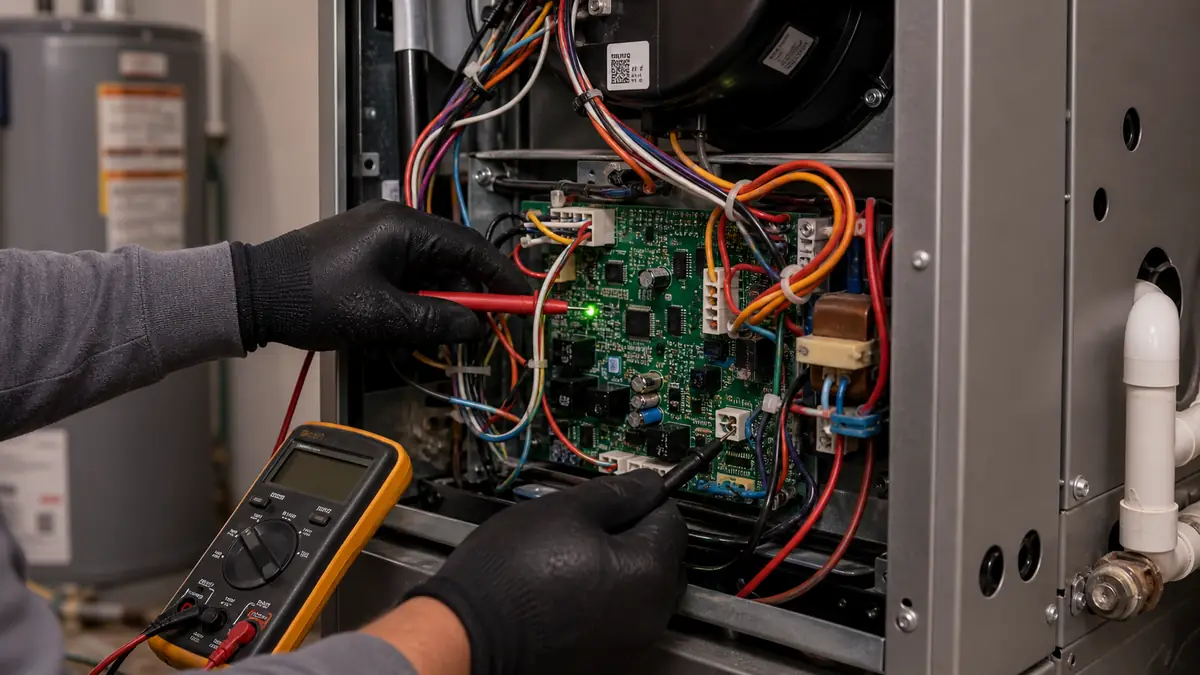
What does 9 flashes mean on a Trane furnace?
The hot-surface igniter is the glow stick that lights the burners. On a call for heat, after the inducer proves draft, the control board sends 115V to the igniter so it glows orange-hot, then opens the gas valve so the gas crosses that hot surface and lights. Nine flashes means the board flagged a fault in that igniter circuit or in the line-to-24V-common path that powers the control logic. Either the igniter is electrically open, the wiring feeding it is broken, or the 24V reference the board uses is unstable. The board reports the circuit problem instead of letting the sequence stumble forward.
The key word is circuit. A 9-flash is not the furnace saying it failed to light - that is a different code about flame. A 9-flash is the furnace saying the path that powers ignition is not right. That points us straight at three things in order: the igniter element, the wires and connectors that feed it, and the 24V common and ground that the control board needs to see clean.
Why do Trane igniters fail in Woodland Hills homes?
Hot-surface igniters are a wear part - silicon-carbide or silicon-nitride elements that glow to over 2,000 F every ignition and grow more brittle with each thermal cycle. They simply age out, often around the 4-to-7-year mark, and crack on a cold-start thermal shock. In Woodland Hills the heating season is short and concentrated - this far-western San Fernando Valley heat pocket runs hot summers, so the furnace sits dormant for months, then gets hammered during the brief cold spells when the Santa Monica Mountains stop trapping warmth. That idle-then-hammer pattern is hard on an aging igniter, which is why so many 9-flash calls land on the first genuinely cold night of the year.
House age matters for the wiring side. The post-war tract and mid-century ranch homes around Walnut Acres and Warner Center often have furnaces that were retrofitted into tight closets or attics, where igniter leads run near hot metal and connectors loosen over decades of expansion and contraction. Add the fine, dry valley dust that settles on every terminal up there, and you get corroded 24V commons and marginal grounds that can mimic an igniter fault. In the newer luxury rebuilds south of Ventura Boulevard the equipment is younger, so a 9-flash there is more often a genuinely failed igniter than a wiring gremlin.
How do you diagnose a Trane 9-flash, step by step?
We move element-first, then wiring, then board, because that order matches how often each one is the real culprit. With power off, we ohm the hot-surface igniter across its leads - a healthy one reads in the rough 40-to-90-ohm band cold, while an open reading means the element has failed and is the whole story. If the igniter ohms out fine, we restore power and watch for 115V actually arriving at the igniter on a heat call; voltage commanded by the board but not reaching the element points to a broken lead or connector, not the igniter. The table below maps the sequence.
| Step | What we read / look for | Typical 2026 cost lane |
|---|---|---|
| Look | Cracked, chipped, or chalky-white igniter tip; backed-out connectors | Power off first |
| Ohm the igniter | A good hot-surface igniter reads roughly 40 - 90 ohms cold; open = failed | $150 - $400 |
| Read 115V to igniter | Board commands igniter but no line voltage arrives | Wiring / board |
| Check the 24V common | Loose or corroded common breaks the control reference | $109+ within visit |
| Confirm ground | Poor chassis ground can spoof an igniter-circuit fault | $109+ within visit |
If the igniter and its wiring are clean, we move to the 24V common and chassis ground - a loose common or a poor ground can make a healthy igniter circuit read as a fault, and chasing the board before checking the ground is how people overspend. Only when element, wiring, voltage, and ground all check out do we suspect the control board itself.
What can I safely check, and what should I leave to a pro?
Safe homeowner checks: kill power at the switch and breaker, pull the blower door, and look at the igniter. A visible crack, a chipped tip, or a chalky-white element is a failed igniter you have now identified. You can also eyeball the igniter connector and gently reseat one that has obviously backed out. Leave to a pro: actually replacing the igniter (the element cracks if you touch it with bare skin - it must be handled by the ceramic base), metering the 115V and 24V circuits, and anything involving the gas valve or control board. This is a gas appliance, so the wiring and combustion side belong to a tech. For the brand-wide picture, see our Trane fault codes guide, and for a furnace that will not fire at all, our emergency service.
When is a 9-flash code urgent?
A 9-flash rarely poses a combustion danger the way a venting code does - a furnace that will not power its igniter simply will not light, so it fails safe and gives you no heat rather than a hazard. The urgency is about comfort and timing. If it happens on a cold Woodland Hills night and the house is dropping below comfortable, treat it as same-day, especially for older residents. If you smell gas at any point, that is a separate emergency - leave and call your gas utility first. Otherwise, because an igniter is a fast, stocked-on-the-truck fix, most 9-flash calls are resolved in a single visit. If the diagnosis turns up tired wiring or a control board on its way out, our heating repair page covers how we handle the larger fix and verify the furnace through a full ignition cycle afterward.
Common questions
What does 9 flashes mean on a Trane furnace?
Nine flashes points to the hot-surface igniter circuit or a problem on the line-to-24V-common path that feeds the control board. In plain terms, the board tried to send power to the igniter and either saw no igniter, an open igniter, or a voltage/grounding fault that broke the circuit. The most common single cause is a cracked or burned-out hot-surface igniter, but loose igniter wiring and a poor 24V common can read the same way.
Can a homeowner fix a Trane 9-flash code?
The safe homeowner part is observation. Pull the blower door (power off) and look at the igniter - a hairline crack or a white, chalky tip is a giveaway it has failed. You can confirm power is fully off and reseat a connector that has obviously backed out. Replacing the igniter itself is doable but easy to crack if you touch the element with bare fingers, and a 24V-common or board fault is meter work, so most homeowners are better handing it off once they have spotted the symptom.
Will a bad igniter always show 9 flashes?
Not always. A failed hot-surface igniter can also leave you watching the furnace try, fail to light, and lock out on an ignition-failure code instead, depending on the model and where in the sequence it quit. Nine flashes specifically means the board flagged the igniter circuit or its 24V supply rather than a no-flame result. That distinction is useful - it tells us to test the igniter and its wiring first, not the flame sensor or gas valve.
How much is a Trane 9-flash repair in Woodland Hills?
A hot-surface igniter is the usual fix and runs about $150 to $400 installed, igniter plus labor. If the real fault is loose igniter wiring or a poor 24V common, the correction can fall within a standard diagnostic visit starting at $109. A failed control board is the high end and far less common on a 9-flash. We test the igniter resistance and the 24V path before quoting so you are not paying for a board the furnace does not need.
Related: Trane fault codes, 3 flashes (pressure switch), emergency service, and heat pump repair.