Emergency AC Repair in Woodland Hills
The honest answer: When a heat advisory pushes Woodland Hills, CA (91364, 91367, 91371) past 100 F and your Trane quits, Woodland Hills Trane HVAC moves no-cool homes to the front of the day, fixing most heat-wave failures with a stocked $150 to $450 capacitor or contactor; call (213) 513-5436 or book online. We are independent, not Trane-authorized.
Facts and figures
- Heat-wave no-cool calls get priority across Woodland Hills ZIPs 91364, 91367, and 91371.
- Woodland Hills logs 60 to 80-plus days a year over 90 F - the most heat-wave demand in the city.
- The most common heat-wave failure is a run capacitor on an XR or XL condenser, stocked on the truck.
- Diagnostic credited toward most repairs; emergency and after-hours rates quoted up front.
- Hours: Weekdays 6am-8pm, emergency service on call; emergency service on call.
- Independent and not Trane-authorized.
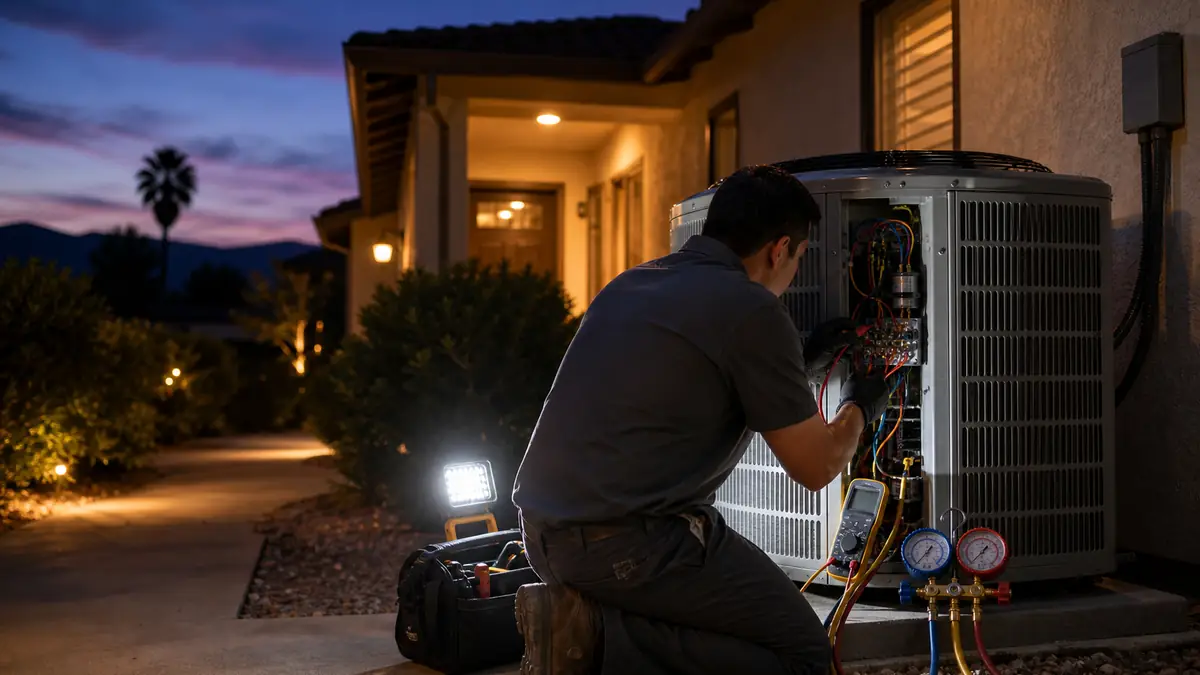
What should I do the moment my AC dies in a heat wave?
First, turn the system off at the thermostat. A failing AC often ices its indoor coil, and running it that way only makes it worse; powering down lets the coil thaw so the tech can diagnose. Then change a clogged filter, drop the blinds on west-facing rooms, and run ceiling fans to buy time. If you smell burning or see sparks at the outdoor unit, pull the disconnect and leave it off. Then call us and say it is a no-cool emergency.
What usually fails in a Woodland Hills heat wave?
The heat itself is the culprit. When a condenser sits in 102 F air running near full duty cycle, the weakest electrical part gives out first - almost always the run capacitor, then the contactor. Both are stocked on our truck, so a true no-cool emergency is frequently fixed on the first visit. Here is how the common emergency calls triage.
| Symptom | First move / likely cause | Typical 2026 cost lane |
|---|---|---|
| No cool, condenser hums, 102 F outside | Failed run capacitor - stocked, same-visit fix | $150 - $450 |
| No cool, condenser totally silent | Tripped or welded contactor / lost 24V | $150 - $450 |
| Burning smell or sparks at the unit | Pull the disconnect; electrical fault - do not restart | Diag first; $109+ |
| Water flooding from the indoor unit | Clogged condensate drain or failed pump | $150 - $600 |
| Breaker trips every time AC starts | Shorted compressor, motor, or wiring | $150 - $3,500 |
What happens step by step on an emergency call?
A no-cool emergency follows a fast, fixed sequence so we lose no time on a 103 F afternoon:
- Triage on the phone. We confirm it is a true no-cool with vulnerable occupants or an electrical-safety issue, and slot it ahead of routine work.
- Stabilize on arrival. If the indoor coil is iced, we get the system off the cooling call so it can thaw while we work the outdoor unit.
- Meter the usual suspects. Capacitor microfarads first, then contactor pull-in and the condenser fan motor - the three parts that fail in heat-soak.
- Check charge and controls. A quick superheat or subcooling read, plus any plain-language alert on an XL850 or XL824 communicating system.
- Fix from the truck. A stocked capacitor, contactor, or fan motor goes in on the spot; the price is quoted before the part comes out of the van.
- Verify the restart. We confirm compressor amp draw and a real temperature split across the coil so the repair holds through the rest of the heat wave.
What do you stock for Trane no-cool emergencies?
The truck is loaded for the failures this heat pocket actually produces on Trane equipment, across the lineup running in local homes:
- Dual-run capacitors in the common ratings for XR and XL condensers - the number-one heat-wave fix.
- Contactors sized for single-stage and two-stage units, often swapped alongside the capacitor.
- Condenser fan motors in the sizes that fit most XR13 through XR17 and XL18i condensers.
- Float switches, fuses, and basic controls for the condensate-trip and lost-24V calls that masquerade as a dead AC.
Variable-speed XV18 and XV20i faults that trace to the Climatuff inverter or a ComfortLink communicating board are the exception - those high-dollar parts are diagnosed on site but usually ordered, since guessing at a board is how a repair bill triples.
What does an emergency Trane repair cost here?
The part decides the bill, not the urgency, though priority and after-hours timing can add to the rate - which we quote before we roll. The most common heat-wave fix, a run capacitor, is $150 to $450 installed, the bulk of it trip and labor since the part itself is $10 to $45. A contactor sits in the same lane. A condenser fan motor runs $300 to $700. A clogged condensate drain or failed pump flooding a ceiling is $150 to $600. The four-figure outliers are a shorted compressor at $1,200 to $3,500 and a communicating board at $400 to $2,000. The diagnostic, around $109 to $139, credits toward most repairs.
Why does Woodland Hills get so many emergency calls?
Because it is the hottest neighborhood in the City of Los Angeles. The Santa Monica Mountains block the cooling sea breeze, so the far-western valley bakes - July highs around 94 to 98 F and frequent triple digits. Older Walnut Acres and Vista de Oro ranch systems, often undersized to begin with, run flat-out and fail right when everyone needs them. That is exactly the load this shop is built around.
How do I avoid the next emergency?
Most heat-wave breakdowns are predictable. A run capacitor that meters weak in May will drop out in July; a coil caked with valley dust chokes airflow until the system overheats. A spring tune-up that checks the capacitor, cleans the Spine Fin coil, and verifies charge catches those before the first 100 F day. See our maintenance plans, or read why bills spike on the high energy bills page.
Common questions
What counts as an HVAC emergency in Woodland Hills?
No cool air when the forecast is over 100 F, especially with infants, older adults, or pets in the home; a burning smell or sparking at the condenser; or water pouring from an indoor unit into a finished ceiling. On a 103 F Walnut Acres afternoon, a dead AC is a health issue, not an inconvenience, and we prioritize accordingly.
How fast can you get to a no-cool call here?
During declared heat advisories we reshuffle the day to put no-cool homes first across 91364, 91367, and 91371. A capacitor or contactor failure - the most common heat-wave fault - is usually a same-visit fix because we stock those parts. Reach us during operating hours and we will give you a real window, not a vague promise.
What should I do while I wait for the tech in a heat wave?
Switch the thermostat off so a frozen coil can thaw, change a clogged filter, close blinds on west-facing windows, and run ceiling fans. If you smell burning or see sparks at the condenser, pull the disconnect or flip the breaker and do not restart it. Move anyone vulnerable to the coolest room or a cooling center.
Do you charge more for emergency or after-hours service?
Priority and after-hours calls can carry a higher rate than a routine weekday visit, and we tell you the number before we roll. The diagnostic is still credited toward most repairs. We would rather quote it straight than surprise you on the invoice during an already stressful 105 F afternoon.
Can most heat-wave breakdowns be fixed on the first visit?
Most, yes. The two failures that strand a Trane in a heat wave - a dead run capacitor and a pitted contactor - are stocked on the truck along with common condenser fan motors for XR and XL units, so they are typically a same-visit fix. A Spine Fin refrigerant leak, a TXV, or a ComfortLink communicating board on an XV system can need a part order and a return trip, but those are the minority of no-cool emergencies.
Is it dangerous to keep running my Trane AC after it stops cooling?
It can be. A unit that keeps calling for cool with a failed part often ices its indoor coil solid, and running the blower against a block of ice can damage the motor and flood the pan when it melts. If you smell burning or see sparks at the condenser, that is an electrical fault - pull the disconnect or flip the breaker and leave it off. Switch the system off and let us diagnose it.
Related: AC repair, water leaking from the unit, maintenance plans, and AC noises.