Trane Furnace 3 Flashes in Woodland Hills
The honest answer: A Trane furnace flashing 3 in Woodland Hills, CA (91364, 91367, 91371) is a pressure-switch fault - the inducer is not proving draft, usually from a blocked flue, weak inducer, or cracked sensing tube. Do not keep resetting it; call (213) 513-5436 or book online and we meter the draft chain.
Facts and figures
- Three flashes = a pressure-switch / draft-proving fault on a Trane gas furnace.
- The inducer must close the pressure switch before the igniter is allowed to light.
- Common causes: blocked flue, weak inducer, cracked sensing tube, plugged condensate trap.
- A pressure switch runs about $150 to $350; an inducer motor about $300 to $700.
- It is a safety lockout - repeating resets can let combustion gases spill.
- Service area: Woodland Hills 91364, 91367, 91371; hours Weekdays 6am-8pm, emergency service on call.
- Independent and not Trane-authorized.
What does 3 flashes mean on a Trane furnace?
Every modern Trane furnace runs a draft-proving handshake before it lights. On a call for heat the control board energizes the inducer motor, which pulls a slight negative pressure through the heat exchanger and flue. That vacuum is what closes the pressure switch, and the closed switch is the board's proof that the vent is open and the inducer is moving air. Only then is the igniter allowed to glow and the gas valve to open. Three flashes means that handshake failed: the switch never closed, or it closed and then reopened part way through the cycle. The board does the safe thing and shuts down rather than firing into a flue it cannot confirm is clear.
Because the switch sits at the end of a chain - inducer, sensing tube, flue, and on 90% furnaces a condensate trap - a 3-flash code is a symptom with several possible roots. The blink does not tell you which link broke. That is why a thorough diagnosis matters more than a parts-cannon: a tech who reads the actual vacuum the inducer produces can tell a tired motor from a blocked vent in a couple of minutes.
Why does a Trane throw 3 flashes in Woodland Hills homes?
The housing stock here shapes the failure pattern. A lot of the mid-century ranch and split-level homes in Walnut Acres and Carlton Terrace have the furnace in a closet or a low attic with the original atmospheric or early induced-draft flue. Those metal vents collect rust scale and the occasional bird or rodent nest at the cap, and a partial blockage shows up first as a 3-flash on the coldest mornings, when the system runs hardest. The hillside contemporary rebuilds south of Ventura Boulevard often went to 90% high-efficiency furnaces with PVC venting and a condensate trap - on those the same code usually traces to a trap clogged with the fine, dry valley dust that this far-western San Fernando Valley heat pocket kicks up all summer.
Climate plays in too. Woodland Hills sits where the Santa Monica Mountains block the sea breeze, so afternoons run hot and dry and the heating season is short and bursty. A furnace that sat idle since spring fires up hard the first cold week, and a marginal inducer or a sensing tube that went brittle in the heat picks that moment to fail. The Santa Ana winds can also push a downdraft at an exposed termination on the hillsides, holding the pressure switch open just long enough to lock the furnace out three times and stop.
How do you diagnose a Trane 3-flash code?
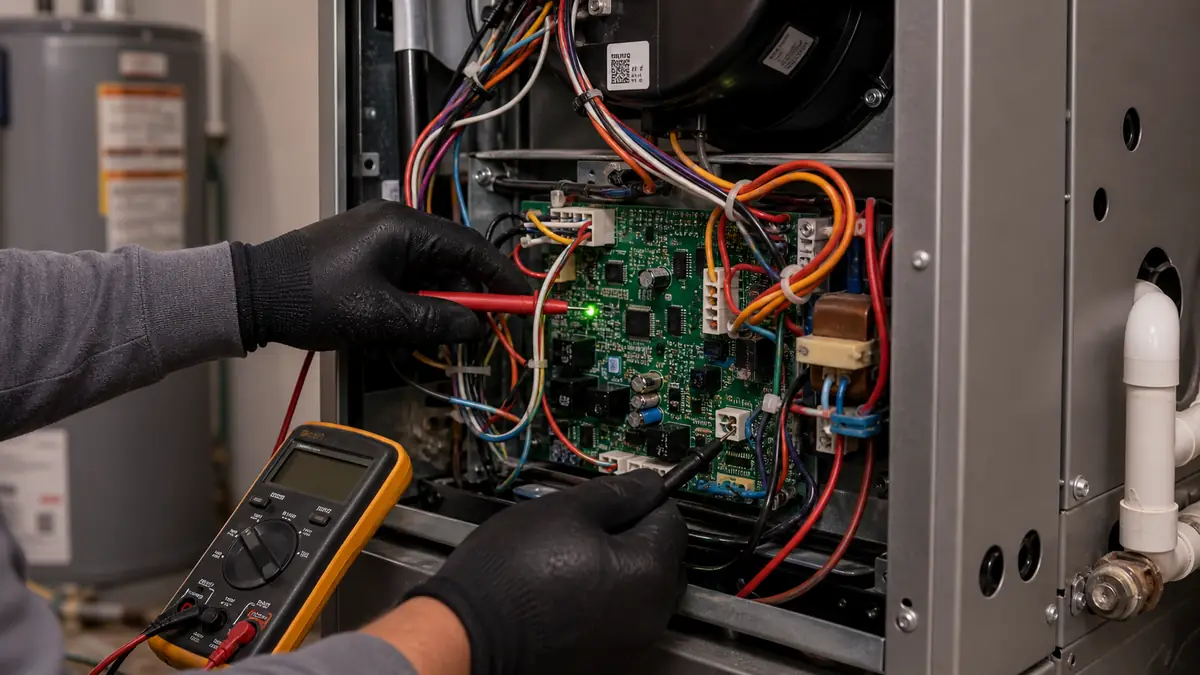
We work the draft chain in order with instruments, not guesses. First we watch the sequence: does the inducer even spin on a call for heat? If it does not, we read for 115V at the inducer; power present and no spin means a seized or failed motor. If it spins, we put a digital manometer on the pressure-switch port and read the actual inches of water column the inducer is pulling, then compare it to the rating stamped on the switch - typically around negative 0.40 to negative 1.0 in. w.c. depending on the model. A switch that should close at, say, negative 0.50 but only sees negative 0.20 of vacuum tells us the inducer is weak or the vent is restricted, not that the switch is bad.
From there we check the sensing tube for cracks and the trap and flue for blockage, and we ohm the switch itself - a good switch reads open at rest and closes to continuity once the rated vacuum is present. We also confirm the inducer's amp draw against its nameplate; a motor pulling high amps and turning slow is on its way out even if it still closes the switch today. The whole point is to separate the cheap fix from the expensive one before any part is ordered.
What can I safely check before calling a pro?
Start with the filter - a badly clogged filter does not usually trip a 3-flash directly, but airflow and combustion problems travel together, so rule it out. Then look at the flue termination outside: clear leaves, a bird screen packed with debris, or anything stuffed into a sidewall PVC vent. Inside, look for an obvious sensing tube that has popped off the inducer or the switch and reseat it gently if it has. Match what you see to the table below.
| What you observe | Likely cause / first check | Typical 2026 cost lane |
|---|---|---|
| Inducer does not spin | No 115V to inducer, seized bearing, or failed motor | $300 - $700 |
| Inducer spins, switch stays open | Blocked flue, cracked sensing tube, or weak inducer | $150 - $700 |
| Switch closes then reopens mid-cycle | Plugged condensate trap or restricted vent on a 90% unit | Diag first; $109+ |
| Switch contacts welded / will not open | Failed pressure switch reading a false closed | $150 - $350 |
| Code only on windy or cold mornings | Marginal draft, downdraft at the termination | Diag first; $109+ |
What you should not do is jumper the pressure switch or tape over the code. That bypasses the one safety that keeps the furnace from running with a blocked vent. For the full code map, see our Trane fault codes guide.
When is a 3-flash code urgent?
A single 3-flash on the first cold morning that clears and never returns is usually a one-time draft hiccup. It becomes urgent when it repeats, because a furnace that genuinely cannot prove draft should not be forced to run - that is a carbon-monoxide and spillage risk, not just an inconvenience. It is also urgent when it leaves you with no heat during a cold snap, or when you smell exhaust near the furnace. In those cases shut the system off and call our emergency service rather than resetting it. If the diagnosis points to the inducer or a tired control, see heating repair for how we handle the part replacement and the post-repair combustion check.
Common questions
What does 3 flashes mean on a Trane furnace?
Three flashes is a pressure-switch / draft-proving fault. The inducer motor is supposed to start, pull a slight vacuum, and close the pressure switch to prove the flue is clear before the igniter ever lights. If that switch does not close, or closes then reopens, the board reads three flashes and refuses to fire. The common causes are a blocked flue, a weak inducer, a cracked sensing tube, or a plugged condensate trap.
Can I fix a Trane 3-flash code myself?
Sometimes the easy part is yours. Swap a clogged filter, pull anything that fell into the flue termination outside, and look for a sensing tube that slid off its port. Those are safe homeowner checks. But anything past that - testing the switch with a manometer, replacing an inducer, or clearing a sealed condensate trap on a high-efficiency furnace - is gas-appliance work that should go to a tech, because a furnace that will not prove draft can be a venting safety issue.
Is a 3-flash code dangerous in my Woodland Hills home?
The code itself is the safety working - the furnace locked out instead of firing into a blocked flue, which is exactly what you want. The danger is overriding it. If you keep cycling power to force ignition, you defeat the one control that stops combustion gases from spilling. Treat a repeating 3-flash as a stop-and-call, not a reset-and-hope, especially on the older atmospheric furnaces in Walnut Acres and Vista de Oro.
How much does it cost to fix a Trane 3-flash in Woodland Hills?
It depends on which link in the draft chain failed. A blocked flue or plugged condensate trap is often cleared within a standard diagnostic visit starting at $109. A pressure switch runs about $150 to $350 installed. A failed inducer motor, the priciest common cause, runs roughly $300 to $700. We meter the switch and the inducer before quoting, so you pay for the part that actually failed.
Related: Trane fault codes, 9 flashes (igniter circuit), emergency service, and heat pump repair.